.cn Country-Code Names
Register the extension that mainland Chinese users recognise as local. A .cn address signals clear intent to serve the Chinese market and sits naturally beside a global .com in your brand portfolio.


Try .cn, .com, .net or any other extension.
A domain name is often the first thing a Chinese-speaking customer sees of your brand, whether it appears on a product label, a social post or a search result. Server in China lets you search for and register .cn, the country-code extension for China, together with a range of other extensions, and connect them directly to your Hong Kong VPS or dedicated server. Use the search box on this page to check whether the name you want is available.
Each registry sets its own rules, and those for .cn can include requirements about the registrant and supporting information. These rules are decided by the registry and can change, so we explain the current position when you order. Domain prices are shown at checkout or provided on request. Please note that our hosting itself is located in Hong Kong, not mainland China.
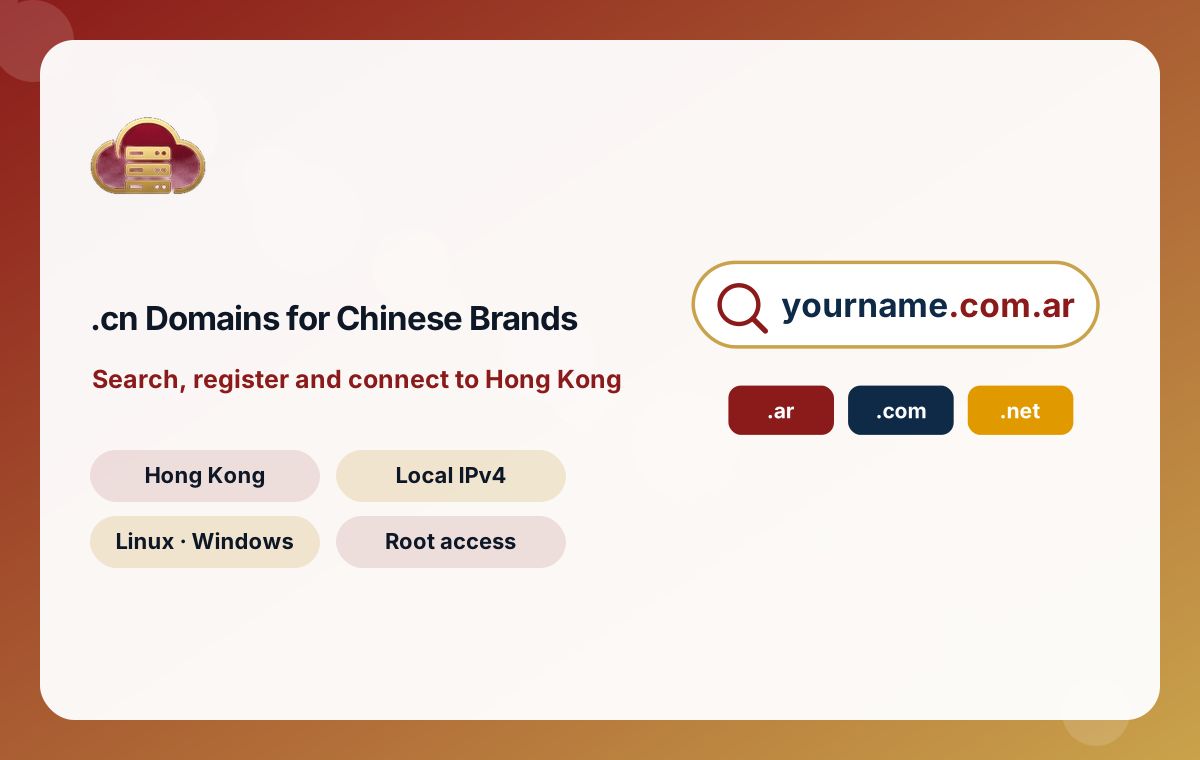
Register the extension that mainland Chinese users recognise as local. A .cn address signals clear intent to serve the Chinese market and sits naturally beside a global .com in your brand portfolio.
Pair .cn with other extensions for international visitors, regional campaigns or defensive registrations. Available extensions and their prices appear at checkout, or our sales team can quote them on request.
Point A, AAAA, CNAME, MX and TXT records at your Hong Kong VPS or dedicated server, so the domain, the website and business email all come together on infrastructure you control.
Registry requirements for .cn and other extensions are set by each registry and can change. We describe what is currently needed in plain terms before you commit, so there are no surprises later.
Manage domain renewals alongside hosting invoices in the ServerSlot client area. Keeping everything together reduces the risk of a forgotten renewal taking a busy storefront offline.
Questions about registration, transfers or DNS records go to our support team through a ticket. Engineers who also look after your server can trace a problem from the domain all the way to the application.
Country-code domains carry meaning. For many mainland users, a .cn address indicates that a business has made a deliberate commitment to the Chinese market rather than simply translating an international site. That impression can support trust, particularly for categories where buyers want reassurance that after-sales service and communication will be in Chinese.
A .cn domain is also short and easy to remember, which matters for packaging, print advertising and offline materials. Many brands choose to display a .cn address on materials aimed at the mainland and a different extension on materials for Hong Kong, Taiwan or international audiences, while every address leads to the appropriate language version of the site.
Registering a domain does not change where your server is located. Our hosting is in Hong Kong. The domain is a naming decision; the server location is a separate infrastructure decision, and we keep both clear for our customers.
The .cn extension is administered by its national registry, which publishes the policies that registrars must follow. These policies typically cover who may hold a domain, what registrant information must be supplied and whether supporting documents or identity verification are needed before a name becomes fully active.
Requirements are not fixed forever. Registries revise their rules from time to time, and enforcement can differ between individual and organisational registrants. For that reason we do not publish a static list of conditions on this page. When you order, we explain what the registry currently asks for and guide you through providing it.
Plan for verification to take some time, and do not schedule a product launch for the same day as a new .cn registration. Registering a few weeks ahead gives room to complete any steps the registry requires and to test DNS before customers start visiting.
Western naming habits do not always translate. Before registering, consider how the name will be typed, spoken and remembered by your audience.
Test candidate names with native speakers from each target market. A name that sounds natural to a Shanghai customer may be read differently in Cantonese or by a Taiwanese audience, and a short conversation can prevent an expensive rebrand later.
Few cross-border brands rely on a single domain. A typical portfolio combines a global extension for the main international site, .cn for the mainland audience and additional names for specific markets, campaigns or product lines.
There are several reasons to register more than one extension:
Search for the extensions you want with the domain search box. Availability and prices for each are shown at checkout, or you can ask our sales team for a quote that covers your whole portfolio.
Once a domain is registered, DNS records connect it to your hosting. For a site on a Hong Kong VPS or dedicated server, a typical setup looks like this:
You can host DNS with your registrar, on your own server through a control panel or with a dedicated DNS provider. Whichever you choose, keep TTL values moderate during setup so mistakes can be corrected quickly, then raise them once the configuration is stable. Our engineers can help check records through a support ticket.
Multilingual brands must decide how domains relate to language versions. Three patterns are common, and all work with a single Hong Kong server.
A .cn domain leads to the simplified Chinese site, while other extensions lead to traditional Chinese and English versions. This gives each audience a clearly local address, but authority for search engines is spread across several domains.
All languages live on one domain in folders such as /zh-hans/ and /zh-hant/, while .cn and other extensions redirect to the relevant folder. Authority is concentrated, and maintenance is simpler.
A middle ground that keeps one registered name but separates sites technically.
Whichever structure you adopt, use hreflang annotations and consistent redirects, and avoid serving identical content on multiple domains without canonical tags.
Brands entering Chinese-speaking markets sometimes find that their name, or a close variation, has already been registered by someone else. Securing the domains you need early is one of the simplest forms of brand protection available.
Consider registering the main brand in .cn and the extensions most relevant to your other markets, along with obvious variations such as the pinyin form of a Chinese brand name. Keep registrant details accurate and up to date, because outdated contact information can complicate renewals, transfers or any future dispute.
Domains work alongside other forms of protection such as trademarks, which are handled through separate legal processes. If brand protection is a serious concern, talk to a specialist advisor in addition to securing your domain names, and make sure your marketing team knows which domains the company officially owns.
A lapsed domain can take a storefront and its email offline in an instant, so treat renewals as seriously as server payments. Managing domains and hosting in the same ServerSlot client area keeps invoices together and makes it easier for finance teams to spot upcoming renewals.
Good habits include enabling automatic renewal where available, using a company email address rather than a personal one for domain notices and keeping payment details current. Payment can be made by Visa, Mastercard, PayPal, bank transfer or cryptocurrency.
If you want to move an existing domain to us, transfer procedures and timeframes depend on the registry for each extension. Some extensions require an authorisation code, and some registries apply additional checks. Open a ticket with the domain names you wish to move, and we will explain the current process and any steps you need to complete with your existing registrar.
A matching email address, such as service@ followed by your .cn domain, reinforces the local presence that the domain creates. Customers who receive order confirmations, quotes or support replies from the same domain they visited are more likely to trust the message.
You can host mail on your Hong Kong VPS with a control panel or mail server software, or use a separate email provider. In both cases, configure DNS correctly: MX records to direct incoming mail, SPF to list authorised senders, DKIM to sign outgoing messages and DMARC to tell receiving servers how to handle mail that fails checks.
Test delivery to the mailbox providers your customers use most, including those common in mainland China, Hong Kong and Taiwan. Mail that is correctly authenticated and sent from a well-maintained server has a much better chance of reaching the inbox rather than a spam folder.
If you are also ordering hosting, place both orders together so the server is ready when the domain becomes active, and your launch can proceed without delay.
Agencies registering names on behalf of clients should agree in writing who will be the registrant of record. In most cases the client company should own its domains, with the agency acting as technical contact, so that ownership is never in doubt if the working relationship changes. Keep a shared register of every domain, its renewal date and where its DNS is hosted.
Yes. Use the domain search box on this page to check availability, then complete the order in the client area. The .cn registry sets its own requirements for registrants, which can change over time, so we explain what is currently needed before you commit. The price is shown at checkout or provided on request.
No. A domain extension is only a name; it does not determine server location. Our hosting is in Hong Kong, not mainland China. You can point a .cn domain at a Hong Kong VPS or dedicated server, and visitors will reach the site through the domain name as usual.
Requirements are set by the registry and can change, and they may differ for individuals and organisations. They can include registrant information and, in some cases, identity or supporting documents. Because the rules change, we explain the current requirements at the time of your order rather than publishing a fixed list here.
We do not publish a fixed domain price list on this page. The current price for .cn and every other extension is shown at checkout, and our sales team can provide a quote on request, which is useful when you plan to register several domains for a brand portfolio at the same time.
Besides .cn, a range of other extensions is available, including options suitable for international sites and regional campaigns. Use the domain search box to see availability for your chosen name. Prices and any extension-specific registry requirements are shown at checkout or can be requested from our sales team.
Create an A record for the root domain and for www pointing to your server's IPv4 address, add MX records for email and TXT records for SPF, DKIM and DMARC. DNS can be hosted at the registrar, on your own server or with a DNS provider. Our engineers can check the configuration through a ticket.
It depends on your audience. Pinyin versions of a Chinese brand name are intuitive for mainland users, while an established English brand may be better recognised internationally. Many brands register both and redirect one to the other. Test candidate names with native speakers from each market before deciding.
Often yes, but transfer rules depend on the registry for each extension. Some require an authorisation code and additional checks, and timeframes vary. Open a ticket listing the domains you want to move, and we will explain the current process and the steps to complete with your existing registrar.
Tell us where your users are and what you plan to run. An engineer will reply with a recommendation through the ticket system.
We use essential cookies to run this site and remember your settings. With your consent we also use optional cookies for analytics. Read our privacy terms.